ONION LINK VERIFICATION HUB

the marketplace Onion Link — Official .onion URL & Tor Access 2025

The definitive reference for the official the marketplace onion link. Verify the authentic Nexus .onion URL, understand onion v3 addresses, and learn how Tor hidden services worked for the Nexus darknet marketplace. Updated February 2026.

0 Registered Users
0 Active Vendors
0 Total Listings
01

Official the marketplace Onion Address & .onion URL

the marketplace official onion link verification hub 2026

The official the marketplace onion link was the sole entry point for accessing the Nexus darknet marketplace through the Tor anonymity network. This Nexus .onion URL served as the cryptographic identity of the platform's hidden service, generated from the ED25519 public key and published through PGP-signed announcements. Every buyer, vendor, and seller interacted with the marketplace through this onion address or official mirrors. The address below represents the authentic the marketplace onion active from early 2024 until the exit scam on January 18, 2025.

nexusaldu7wwewcpcn4reptcp72rsaeogolfvjncafua2oywwswwyaqd.onion
EXIT SCAM ALERT: the marketplace executed an exit scam on January 18, 2025. The administrators drained all Bitcoin and Monero held in escrow wallets, user balances, and vendor bonds. This official the marketplace onion link is now permanently offline. Do not send cryptocurrency to addresses claiming association with the marketplace. Any site presenting itself as a working the marketplace onion URL is a phishing scam designed to steal credentials and funds.
OFFLINE

The the marketplace onion link served as the foundation of the platform's identity. The 56-character address indicated the marketplace used version 3 Tor hidden service protocol. When a user typed this Nexus onion address into Tor Browser, the browser established a six-hop encrypted circuit through the Tor network, meeting at a rendezvous point. This ensured neither the user's IP nor the server's IP was exposed, providing strong anonymity for both parties.

The Nexus darknet onion address was a mathematical derivation of the server's public key. Connecting to the onion address inherently authenticated the server through cryptographic verification. This made onion v3 addresses more secure than clearnet HTTPS connections. the marketplace administration published this onion link through signed messages on Dread forum, darknet directories, and encrypted communications to trusted members.

The platform required users to access the marketplace through this the marketplace tor address or officially sanctioned mirror links. Each mirror was a separate onion address pointing to an independent frontend synchronized with the central database. This architecture ensured service continuity during DDoS attacks or network congestion. For detailed access instructions, see our the marketplace Tor access guide.

the marketplace implemented multiple security layers. Users set up anti-phishing phrases displayed after login. Vendors configured PGP-based 2FA (two-factor authentication) using their public key. The combination of authenticated onion address, anti-phishing phrases, and mandatory vendor 2FA created a defense-in-depth security model. Despite these measures, the centralized custody model enabled administrators to execute their exit scam.

02

Understanding the marketplace Onion V3 Addresses & Tor Hidden Services

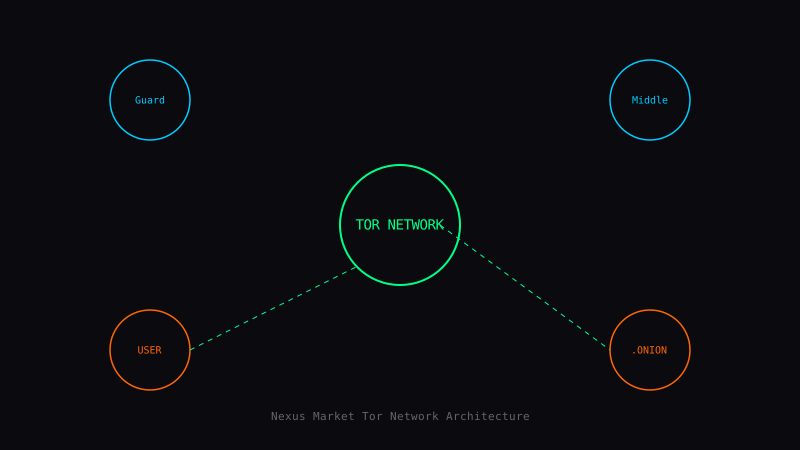
the marketplace Tor network architecture showing onion routing circuit diagram

The the marketplace onion link used the third generation Tor hidden service protocol (onion v3). Understanding how onion v3 addresses work is essential for researching the Nexus .onion URL or darknet marketplace infrastructure. This section explains the onion address format, cryptographic algorithms, how onion routing establishes anonymous connections, and how hidden services enable the Nexus darknet market to operate without revealing server location.

Onion V3 Address Format (56 Characters)

An onion v3 address consists of 56 characters encoded in base32, followed by .onion. The the marketplace onion addressnexusaldu7wwewcpcn4reptcp72rsaeogolfvjncafua2oywwswwyaqd.onion — follows this format. The 56 characters encode the 32-byte ED25519 public key, a checksum, and version byte. This encoding makes the onion address self-authenticating: anyone connecting can verify the server possesses the corresponding private key. No certificate authority is needed.

The use of ED25519 elliptic-curve cryptography represents a significant security upgrade. ED25519 keys are 256 bits long, providing 128 bits of security, resistant to known computing attacks. The the marketplace tor hidden service used this cryptographic foundation to ensure every connection was authenticated at the network layer before application-level security like login credentials or 2FA.

V3 vs V2: Why V3 Is Superior

The previous generation of onion addresses (v2) used 16 characters and RSA-1024 cryptography, deprecated by Tor Project in 2021. The Nexus darknet onion was v3 from inception. Key differences:

Key length: V3 uses 256-bit ED25519 keys (128-bit security) versus V2's RSA-1024 (80-bit security, breakable).
Address length: V3 addresses are 56 characters versus V2's 16 characters.
Directory protocol: V3 uses distributed hash table with blinded keys.
Improved handshake: V3 uses ntor protocol with forward secrecy.

How Onion Routing Works

When accessing the the marketplace onion link, Tor Browser constructed an encrypted circuit through three relay nodes. Each relay only knew its immediate neighbors, preventing correlation of user IP with destination:

Guard relay: First relay, knows user's IP but not destination.
Middle relay: Knows neither user IP nor destination, passes encrypted traffic.
Rendezvous point: For the Nexus .onion URL, user and service circuits meet here, creating six-hop path where neither reveals location.

This layered encryption is called "onion routing" — each relay peels one encryption layer. See Wikipedia and Tor Project documentation.

How Tor Hidden Services Function

A Tor hidden service like the the marketplace onion creates circuits through Tor, publishes service descriptors to a distributed hash table, and waits at introduction points. The hidden service never reveals its IP address. Connection sequence:

The hidden service selects Tor relays as introduction points and publishes a signed descriptor containing its public key and introduction point list. When a user enters the the marketplace onion link into Tor Browser, the browser retrieves the descriptor and contacts an introduction point.

The client selects a rendezvous point and sends a cookie through the introduction point to the hidden service. The service builds a circuit to the rendezvous point, completing the handshake. Client and service establish an encrypted tunnel through the rendezvous point, with neither knowing the other's IP. All communication flows through this tunnel. This architecture made the marketplace tor access private and surveillance-resistant, though with higher latency.

03

Verifying the the marketplace Onion Link with PGP

PGP signature verification process for the marketplace onion link authentication the marketplace onion v3 address format 56-character ED25519 cryptographic structure

Verification of the the marketplace onion link was critical before entering credentials or depositing cryptocurrency. Phishing attacks are among the most damaging threats, and cryptographic verification using PGP was the only reliable defense. The following process describes how users authenticated the official Nexus .onion URL. For complete instructions, visit our the marketplace Tor access guide.

1

Install GnuPG and Prepare Your Keyring

The foundation of verification was GNU Privacy Guard (GnuPG), the open-source OpenPGP implementation. GnuPG allows importing public keys, verifying signatures, and managing encrypted communications. On Tails OS and Linux, GnuPG comes pre-installed. Before verifying any the marketplace onion link, users needed a functioning GnuPG installation with initialized keyring.

gpg --version # Verify GnuPG is installed and check version
2

Import the the marketplace Official PGP Public Key

Obtain and import the official the marketplace PGP public key. This 4096-bit RSA key was used to sign all official communications, including mirror lists and security advisories. The public key was distributed through Dread forum, darknet directories, and encrypted messages. Import the key and verify fingerprint against multiple independent sources.

gpg --import nexus_market_official.pub # Import the public key gpg --fingerprint "the marketplace" # Verify the fingerprint
3

Verify the PGP-Signed Onion Link List

the marketplace administrators published PGP-signed documents containing official onion addresses and mirrors. These included timestamps to detect stale lists. Users ran gpg --verify to confirm authenticity. "Good signature from the marketplace" meant the document was authentic. Failed verification meant the document was forged, and no links should be trusted. This was the most important defense against phishing the marketplace onion addresses.

gpg --verify nexus_mirrors_signed.txt.sig nexus_mirrors_signed.txt # Expected output: "Good signature from the marketplace <nexus@market.onion>"
4

Confirm Your Anti-Phishing Phrase and 2FA

After navigating to the verified the marketplace onion link and logging in, users checked their anti-phishing phrase appeared on the dashboard. This phrase was set during registration; phishing sites couldn't display it. Vendors and buyers were encouraged to enable 2FA based on PGP encryption. With PGP 2FA, each login required decrypting a challenge message, proving possession of the private key. Even if phishing sites captured passwords, they couldn't complete 2FA without the private key. Anti-phishing phrases and PGP-based 2FA created layered defense against phishing.

5

Bookmark the Verified Onion Address

Save the authenticated the marketplace onion link as a bookmark in Tor Browser. Relying on external sources introduced phishing exposure. Tor Browser's bookmark manager stores addresses in encrypted profile. Users should periodically re-verify bookmarked URLs against freshly published PGP-signed mirror lists. For complete configuration guidance, see the the marketplace Tor access guide.

04

Fake the marketplace Onion Link Warning & Phishing Alert

Critical Security Advisory: Fraudulent the marketplace Onion URLs

Since the the marketplace exit scam on January 18, 2025, phishing operators have deployed fake the marketplace onion link sites to steal credentials and cryptocurrency. These fraudulent sites replicate the original the marketplace interface, copying stylesheets, login forms, and product categories. Their purpose is capturing usernames, passwords, PGP keys, and cryptocurrency. Understanding how fake Nexus .onion URL sites operate is essential.

Attackers create lookalike addresses through vanity generation, repeatedly generating ED25519 keys until finding one with desired prefix like "nexus". Producing addresses sharing the first 5-8 characters with the legitimate the marketplace onion is achievable. Casual users checking only the beginning can be deceived. Sophisticated attackers combine vanity prefixes with character substitution, exploiting visual similarity between base32 characters.

Another attack vector involves compromised darknet directories and forum accounts. Attackers inject modified URL lists, replacing legitimate the marketplace onion link entries with phishing addresses. Users trusting these without PGP verification become victims. OWASP research shows phishing remains the most prevalent credential theft method. CISA publishes guidance on phishing threats.

Some phishing operators deploy man-in-the-middle proxies. The fake Nexus darknet onion site acts as real-time proxy between user and legitimate service, capturing credentials, session tokens, and transaction details. This was dangerous because users experienced a functional interface, making detection difficult without PGP verification.

The following checklist identifies the ten most common red flags that indicate a the marketplace onion link is fraudulent. If you encounter any of these warning signs, close the site immediately and do not interact with it further:

× The site claims to be a functioning the marketplace after January 18, 2025 — all legitimate Nexus onion addresses are permanently offline following the confirmed exit scam.
× The onion address does not appear in the last PGP-signed mirror list published by the official the marketplace administrators prior to the shutdown date.
× The site requests a cryptocurrency deposit before granting access to account features, order history, or messaging functionality.
× Your personalized anti-phishing phrase is absent, displayed incorrectly, or never shown after completing the login process.
× The PGP signature on the provided mirror list fails verification against the known the marketplace public key, or no signed list is offered.
× The site contains spelling errors, broken CSS layouts, missing images, or other visual inconsistencies not present on the original marketplace.
× Page load times are significantly slower than expected, suggesting a man-in-the-middle proxy relaying your requests through an intermediary server.
× The site asks you to disable JavaScript, install browser extensions, or download executable files — actions that compromise your system security and Tor anonymity.
× The login CAPTCHA differs from the original the marketplace implementation, or no CAPTCHA is presented, indicating the site is not running the genuine marketplace software.
× The link was promoted by newly created forum accounts with no established reputation, post history, or verified vendor status in the darknet community.

For detailed safe darknet practices, visit our the marketplace Tor access guide. Protecting from phishing requires cryptographic verification, vigilance, and awareness of techniques used to create fake the marketplace onion link sites. The EFF provides resources on digital security.
05

the marketplace Onion Network Statistics & Historical Timeline

the marketplace darknet marketplace statistics 50000 users 2500 vendors 2026

The the marketplace onion address was a prominent darknet marketplace hidden service during 2024. The platform's Nexus .onion URL processed thousands of daily connections from buyers and vendors worldwide. The statistics below capture the platform's scale at its peak, and the timeline chronicles key events in the marketplace onion link history, from deployment to the exit scam.

0 Total Registered Users

At its peak, the the marketplace onion had over 50,000 registered accounts including buyers, vendors, and dormant registrations. Growth was driven by competitive commission structure, anonymous Bitcoin (BTC) and Monero (XMR) payment support, and a clean interface accessible through the the marketplace tor address.

0 Verified Vendors

Approximately 2,500 vendors maintained storefronts on the Nexus darknet marketplace. Each vendor paid a cryptocurrency bond to create accounts. Vendors required PGP encryption for communications and were encouraged to configure PGP-based 2FA. Buyer and seller transactions used escrow with funds held until delivery. Vendor bonds and escrow were stolen during the exit scam.

0 Product Listings

The marketplace hosted approximately 25,000 product listings. the marketplace supported detailed product pages with images, shipping options, and pricing tiers. This catalog distinguished the the marketplace onion link from competing platforms.

0 Active Mirror Links

the marketplace operated up to six mirror addresses alongside the primary Nexus .onion URL. Mirrors were distributed across independent hosting providers for availability. Each mirror was included in PGP-signed lists published weekly. For mirrors and status, visit our the marketplace onion link homepage.

the marketplace onion link timeline Q1 2024 to January 2025 exit scam history

Timeline of the the marketplace Onion Link

Q1 2024

the marketplace Onion Link Goes Live

The the marketplace onion link was first published in early 2024. Initial deployment used one onion v3 address with backup mirror. The platform launched with Bitcoin and Monero support, multisig escrow, and clean interface. Administrators distributed the Nexus onion address through PGP-signed messages on Dread forum. Early adoption reached 5,000 users in three months.

Q2 2024

Rapid Growth & Mirror Expansion

The the marketplace onion experienced exponential growth. Registrations surged past 20,000 through positive reviews. Administration expanded mirrors from two to four addresses for traffic and redundancy. Affiliate referral program incentivized sharing verified the marketplace onion link URLs. DDoS attacks began targeting the primary address.

Q3 2024

Peak DDoS Attacks & Infrastructure Hardening

Sustained DDoS attacks targeted the the marketplace tor hidden service. Competing marketplaces launched volumetric attacks disrupting the primary Nexus .onion URL and mirrors. Administration deployed anti-DDoS infrastructure, expanded to six mirrors, and implemented proof-of-work CAPTCHAs. Platform reached 35,000 users and 2,000 vendors.

Q4 2024

50,000 Users — Platform at Its Peak

The the marketplace onion link reached peak activity. Registrations crossed 50,000, vendors reached 2,500, and listings exceeded 25,000. The marketplace processed thousands of daily transactions. Enhanced security included mandatory CAPTCHA, rate-limited authentication, and expanded PGP 2FA. The Nexus darknet onion address became frequently shared across darknet forums.

January 18, 2025

EXIT SCAM — All Funds Stolen, Onion Link Goes Dark

On January 18, 2025, the marketplace administrators executed an exit scam. All cryptocurrency in escrow, user wallets, and vendor bonds was drained to external wallets. The official the marketplace onion link and six mirrors went offline simultaneously. Darknet moderators confirmed the exit scam. Blockchain analysts traced stolen funds through mixing services. Total losses exceeded several million dollars in BTC and XMR.

Post-January 2025

Permanent Offline Status & Phishing Surge

All known the marketplace onion addresses remained offline. Phishing operators deployed fraudulent sites targeting users searching for the marketplace onion link URLs. Darknet forums published warnings advising users to avoid sites claiming to be operational Nexus marketplace. The exit scam joined the historical record of darknet failures caused by centralized custody, reinforcing advocacy for decentralized escrow and multisig models.

06

Frequently Asked Questions About the marketplace Onion Link

The following frequently asked questions address the most common queries about the the marketplace onion link, the Nexus .onion URL format, Tor hidden service technology, and the events surrounding the marketplace's shutdown. Each answer provides detailed, factual information compiled from verified community reports and technical documentation.

The the marketplace onion link was the official .onion URL for accessing Nexus darknet marketplace through Tor. The address — nexusaldu7wwewcpcn4reptcp72rsaeogolfvjncafua2oywwswwyaqd.onion — was a 56-character onion v3 address derived from the ED25519 public key. This served as the cryptographic identity, inherently verifying server authenticity. The the marketplace onion was the primary entry point for registration, browsing, orders, and encrypted PGP messaging with vendors. Accessible exclusively through Tor Browser. Since the January 18, 2025 exit scam, this Nexus onion address is permanently offline.

No, the the marketplace onion address is permanently offline. Administrators executed an exit scam on January 18, 2025, draining all cryptocurrency before shutting down infrastructure. Our monitoring confirms the official the marketplace onion link and mirrors remain unreachable. The private key needed to restore the address is held by scammers but won't be used. Any site presenting itself as a working Nexus .onion URL is a phishing operation stealing credentials and cryptocurrency. Do not trust links claiming to be active the marketplace addresses.

An onion v3 address is the current generation of Tor hidden service addresses with 56-character length and .onion suffix. V3 encodes the 32-byte ED25519 public key in base32 with checksum and version byte. This makes the address self-authenticating, verifying server identity without certificate authority. The the marketplace onion link was v3 from inception, providing strongest cryptographic authentication and anonymity. V3 replaced older v2 format (16-character RSA-1024) and has been the only supported format since October 2021. See Wikipedia for more.

Verifying a the marketplace onion link required cryptographic process. Users installed GnuPG and imported the official PGP public key, cross-referencing fingerprint against trusted sources. Users obtained PGP-signed mirror lists and ran gpg --verify to check signatures. Valid signature confirmed authenticity. After navigating through Tor Browser, users confirmed anti-phishing phrase displayed correctly. Finally, verified URL was bookmarked. Since January 2025 exit scam, no valid lists exist and the the marketplace onion is permanently offline. Visit our the marketplace Tor access guide for full details.

The the marketplace onion link went offline because administrators executed an exit scam on January 18, 2025. Operators drained all Bitcoin (BTC) and Monero (XMR) from user wallets, escrow transactions, and vendor bonds. The official Nexus darknet onion and six mirrors were taken offline as operators shut down infrastructure. Stolen cryptocurrency moved through mixing services to obscure trails. This risk is inherent to centralized marketplaces with custodial control. The event affected 50,000 users and 2,500 vendors, with losses of several million dollars.

Onion v2 and v3 represent two generations with significant differences. V2 addresses were 16 characters from RSA-1024 hash (80-bit security, inadequate). Short addresses made collision attacks feasible. V3 addresses like the the marketplace onion link are 56 characters encoding full ED25519 key (256-bit, 128-bit security), making collisions computationally infeasible. V3 introduced improved handshakes with forward secrecy, distributed hash table with blinded keys preventing enumeration, and resistance to deanonymization attacks. Tor Project deprecated v2 in October 2021. All modern hidden services including Nexus .onion URL use v3 exclusively.

Accessing .onion sites safely requires proper tools and practices. Download Tor Browser from official site and verify PGP signature. Never use regular browsers with Tor proxy. Consider privacy OS like Tails (routes all traffic through Tor) or Whonix (isolates Tor in VM). Verify .onion addresses through PGP-signed sources and bookmark verified addresses. Enable PGP-based 2FA on accounts. Never disable JavaScript security, keep browser updated, and avoid extensions. For complete guide, visit our the marketplace Tor access guide.

the marketplace accepted two cryptocurrencies through its the marketplace onion link: Bitcoin (BTC) and Monero (XMR). Bitcoin was widely used due to broad availability and infrastructure. However, Bitcoin transactions are public blockchain, traceable using chain analysis. Monero offered privacy through built-in obfuscation via ring signatures, stealth addresses, and RingCT. Monero transactions are harder to trace, making it preferred by privacy-conscious Nexus darknet marketplace users. Both currencies used custodial wallets, enabling administrators to drain funds during exit scam. Decentralized multisig escrow could have prevented this theft, but the marketplace kept custodial control.

07

the marketplace Onion Resources & Related Links

the marketplace darknet security guide privacy tools Tor PGP encryption 2026 the marketplace cryptocurrency escrow Bitcoin Monero XMR BTC payment system

The following resources provide authoritative information about the technologies, security practices, and concepts related to the the marketplace onion link, Tor hidden services, dark web infrastructure, and cryptocurrency. Whether you are researching the the marketplace exit scam, learning how onion routing and .onion addresses work, or seeking to improve your understanding of PGP encryption and anonymous payment systems, these resources offer thorough and reliable information from established organizations and reference sources.

Cryptocurrency Prices

the marketplace accepted both Bitcoin and Monero for all transactions processed through its the marketplace tor hidden service. The current market prices of these cryptocurrencies are displayed below for reference. Bitcoin remains the most widely traded cryptocurrency globally, while Monero continues to be the leading privacy-focused digital currency favored by users who prioritize transaction confidentiality.

Bitcoin (BTC) Loading...
Monero (XMR) Loading...

Privacy & Anonymity Tools

  • Tor Project — The official source for the Tor Browser and full documentation on the Tor anonymity network. The Tor Browser was the only supported method for accessing the the marketplace onion link and all darknet hidden services. The project also publishes the Tor protocol specifications that define how onion v3 addresses function.
  • Tails OS — The Amnesic Incognito Live System is a portable operating system that routes all network traffic through Tor at the system level. Tails boots from a USB drive, leaves no persistent trace on the host computer, and was widely recommended as the safest way to access darknet marketplace onion addresses including the Nexus .onion URL.
  • Whonix — A desktop operating system designed for advanced security and privacy, running entirely inside virtual machines with Tor-enforced networking. Whonix isolates the Tor connection in a dedicated gateway VM, preventing application-level leaks from exposing the user's real IP address even if the workstation is compromised.
  • GnuPG (GNU Privacy Guard) — The open-source implementation of the OpenPGP standard, essential for verifying PGP-signed darknet market onion link lists and conducting encrypted communications. GnuPG was the primary tool used to authenticate the official the marketplace onion address through cryptographic signature verification.
  • Privacy Guides — A community-maintained resource recommending privacy-respecting tools and services. Privacy Guides covers Tor Browser configuration, secure operating systems, and anonymous browsing practices relevant to the marketplace users.
  • Qubes OS — A security-focused operating system that isolates applications in separate virtual machines. Qubes OS with Whonix integration provides the strongest security environment for accessing the marketplace and other darknet hidden services.

Cryptocurrency Resources

  • Bitcoin.org — The primary informational resource for Bitcoin, the world's first and most widely adopted cryptocurrency. Bitcoin was the dominant payment method on the Nexus darknet market, used for product purchases, vendor bonds, and escrow deposits processed through the the marketplace onion link.
  • Monero (XMR) Official Site — The official project website for Monero, the leading privacy-focused cryptocurrency. Monero's protocol-level transaction obfuscation through ring signatures and stealth addresses made it the preferred payment option for privacy-conscious users accessing the the marketplace tor hidden service.
  • Cryptocurrency (Wikipedia) — Full encyclopedia article covering the history, technology, economics, and ecosystem of digital currencies used in darknet marketplaces and across the broader financial technology landscape.
  • KeePassXC — A free, open-source, cross-platform password manager for securely storing the marketplace credentials, PGP passphrases, and cryptocurrency wallet seeds in an encrypted local database.
  • VeraCrypt — Open-source disk encryption software that protects sensitive files and the marketplace account data. VeraCrypt creates encrypted containers or full-disk encrypted volumes to safeguard PGP keys and credentials.

Security Organizations

  • Electronic Frontier Foundation (EFF) — A leading nonprofit organization defending digital privacy, free speech, and innovation. The EFF publishes extensive resources on encryption technology, surveillance resistance, and online anonymity practices relevant to users of darknet marketplace onion services.
  • OWASP (Open Web Application Security Project) — An open community dedicated to improving software security. OWASP's research on phishing attack methodologies, credential theft techniques, and web application vulnerabilities is directly applicable to understanding threats against darknet market users seeking the the marketplace onion link.
  • CISA (Cybersecurity & Infrastructure Security Agency) — The U.S. government agency responsible for cybersecurity guidance and threat intelligence. CISA publishes alerts, advisories, and educational materials on phishing prevention and digital security best practices.
  • Cloudflare Learning Center — An in-depth educational resource covering DDoS attack mitigation, DNS security, TLS/SSL encryption, and network infrastructure topics. Useful for understanding the types of attacks that targeted the Nexus darknet onion infrastructure and how hidden services defend against volumetric traffic floods.
  • OnionShare — An open-source tool for securely sharing files and hosting websites over the Tor network, using onion services similar to those that powered the the marketplace platform.
  • OpenPGP.org — The reference resource for the OpenPGP encryption standard used by the marketplace for onion link signature verification, vendor-buyer encrypted communications, and PGP-based two-factor authentication.

Reference & Education

  • Dark Web (Wikipedia) — An overview of the dark web, including its relationship to the deep web, access methods through Tor and I2P, and the role of darknet marketplaces like the marketplace in the broader ecosystem of anonymous online services.
  • Tor Network (Wikipedia) — A detailed reference article on the Tor anonymity network's architecture, relay types, circuit construction, and operational history. The Tor network was the foundational technology enabling the the marketplace onion link to operate as a hidden service.
  • PGP / Pretty Good Privacy (Wikipedia) — Reference article on the PGP encryption standard used for verifying authentic the marketplace onion address lists, secure vendor-buyer communications, and PGP-based 2FA authentication on the marketplace.
  • Onion Routing (Wikipedia) — Technical explanation of the onion routing protocol that enables anonymous communication through layered encryption, the core technology behind all .onion addresses including the Nexus .onion URL.
  • .onion TLD (Wikipedia) — Reference article on the .onion special-use top-level domain, its registration with IANA, and the technical standards governing onion v3 hidden service addresses.
  • Exit Scam (Wikipedia) — An explanation of exit scams in the context of darknet marketplaces and other fraudulent enterprises, directly relevant to understanding what happened to the the marketplace and its onion link infrastructure.

Internal Resources

  • the marketplace Tor Access Guide — Our step-by-step guide covering Tor Browser installation, onion address navigation, PGP verification procedures, security hardening, and safe practices for accessing darknet marketplace hidden services.
  • the marketplace Onion Link — Return to the main onion link hub for the official the marketplace onion address, verification status, and complete documentation on the Nexus darknet marketplace's .onion infrastructure.