How to Access Nexus Market — Tor Browser Setup Guide 2025
Complete step-by-step guide to accessing Nexus Market through the Tor Browser. Learn how to download, install, and configure Tor for secure Nexus Market access with proper privacy and anonymity settings. This Nexus Market Tor access tutorial covers everything from browser setup to onion link verification.
CRITICAL NOTICE — EXIT SCAM — January 18, 2025: Nexus Market conducted an exit scam on January 18, 2025. The Nexus Market administrators shut down all Nexus Market infrastructure and absconded with all cryptocurrency held in escrow, user wallets, and vendor bonds. Every buyer, seller, and vendor who used the platform was affected. Over 50,000 registered Nexus Market users and 2,500 vendors were impacted, with protected escrow funds and multisig wallet balances stolen. The official Nexus Market onion address is permanently offline:
Any website currently claiming to be a working Nexus Market mirror or access point is a phishing scam designed to steal your credentials and cryptocurrency. This Tor access guide is preserved for educational and historical reference purposes only. Do not attempt to access or log in to any site presenting itself as Nexus Market. For the current status of all known Nexus Market onion URLs, visit our Nexus Market onion link directory.
01
How to Download & Install Tor Browser for Nexus Market Access
Accessing Nexus Market required the Tor Browser, a specialized web browser built on the Mozilla Firefox codebase that routes all internet traffic through the Tor anonymity network. The Tor network operates by encrypting your traffic and bouncing it through a series of volunteer-operated relays distributed around the world, making it virtually impossible for anyone monitoring your internet connection to determine which websites you visit. This onion routing protocol is what enables access to hidden services — websites with .onion addresses that are only reachable through the Tor network. Nexus Market, like all darknet marketplaces, operated exclusively as a Tor hidden service, meaning the Tor Browser was the only legitimate way to access the Nexus Market platform. No regular browser such as Chrome, Firefox, Safari, or Edge can resolve .onion addresses, and any clearnet site claiming to provide Nexus Market access through a standard browser is fraudulent by definition.
The following five-step guide walks you through the complete process of downloading, verifying, installing, and configuring the Tor Browser for secure Nexus Market access. While this Nexus Market Tor guide references Nexus Market specifically, the same procedure applies to accessing any Tor hidden service. Each step includes detailed instructions, relevant command-line examples, and security considerations that are critical for maintaining your anonymity and protecting your privacy when accessing Nexus Market through the darknet. Before the January 2025 exit scam, following this Nexus Market access guide was the recommended first step for any new user seeking to reach the Nexus Market onion link safely.
1
Download Tor Browser from the Official Source for Nexus Market
The first and most critical step in accessing Nexus Market or any darknet marketplace is downloading the Tor Browser exclusively from the official Tor Project website. The Tor Project is the nonprofit organization that develops and maintains the Tor anonymity network and its associated software. Downloading from any other source — including third-party software repositories, file sharing sites, or links posted on forums — introduces the risk of receiving a tampered version of the browser that could contain malware, keyloggers, or surveillance code designed to deanonymize your Nexus Market activity. Attackers have been known to distribute modified Tor Browser installers that appear identical to the genuine software but silently record your browsing history and credentials, specifically targeting Nexus Market users.
The Tor Project provides downloads for Windows, macOS, Linux, and Android. Visit https://www.torproject.org/download/ and select the version appropriate for your operating system. For maximum security when accessing darknet marketplaces like Nexus Market, the Linux version is recommended because Linux operating systems provide stronger process isolation and are less susceptible to the types of malware that commonly target Windows systems. The download page also provides the GPG signature file and the signing key fingerprint, which you will need for the verification step that follows. Always download both the browser installer and the corresponding signature file.
# Download Tor Browser for Linux (64-bit)
wget https://www.torproject.org/dist/torbrowser/13.5/tor-browser-linux-x86_64-13.5.tar.xz

# Also download the signature file
wget https://www.torproject.org/dist/torbrowser/13.5/tor-browser-linux-x86_64-13.5.tar.xz.asc
The Electronic Frontier Foundation maintains detailed guides on using the Tor Browser safely and provides additional context on why anonymous browsing tools are important for protecting civil liberties and privacy rights online. Their Surveillance Self-Defense guide is an excellent companion resource for anyone learning to navigate the Tor network for the first time.
2
Verify the Tor Browser Download for Nexus Market Access
Before installing the Tor Browser for Nexus Market access, you must verify that the download has not been tampered with during transit. This verification process uses PGP (Pretty Good Privacy) cryptographic signatures to mathematically prove that the file you downloaded was produced by the Tor Project developers and has not been modified by a third party. Skipping this verification step when preparing to access Nexus Market means you have no guarantee that the software you are about to install is legitimate. Nation-state adversaries and sophisticated criminal organizations have the capability to intercept downloads and substitute malicious versions specifically targeting Nexus Market users, a technique known as a supply chain attack.
First, import the Tor Browser Developers signing key into your GnuPG keyring. The key fingerprint should match the one published on the Tor Project website and verified across multiple independent sources. Then run the signature verification command against the downloaded installer file. A "Good signature" result confirms authenticity.
# Import the Tor Browser Developers signing key
gpg --auto-key-locate nodefault,wkd --locate-keys torbrowser@torproject.org

# Verify the download signature
gpg --verify tor-browser-linux-x86_64-13.5.tar.xz.asc tor-browser-linux-x86_64-13.5.tar.xz
Expected output for a valid download:
gpg: Good signature from "Tor Browser Developers (signing key) <torbrowser@torproject.org>"
If you see "BAD signature" in the output, do not install the file. Delete it immediately and re-download from the official Tor Project website. Additionally, you can verify the SHA256 checksum of the download file against the published checksum on the Tor Project download page as a secondary verification method:
Compare the output hash against the value listed on the Tor Project download page. Both the PGP signature and the SHA256 checksum must match before proceeding with installation. This dual-verification approach provides defense in depth against supply chain compromise and ensures a trustworthy Nexus Market Tor Browser setup.
3
Install and Configure Security Settings for Nexus Market
Once the download has been verified, extract the Tor Browser archive and run the browser. On Linux, the Tor Browser does not require traditional installation — it runs directly from the extracted directory, which means it can be placed on an encrypted USB drive for portable Nexus Market access. On Windows and macOS, run the installer and follow the on-screen prompts. The Tor Browser will create its own self-contained directory with all necessary components for accessing Nexus Market, including the Tor daemon, browser binaries, and configuration files.
# Extract the archive (Linux)
tar -xJf tor-browser-linux-x86_64-13.5.tar.xz

# Navigate to the directory and launch
cd tor-browser
./start-tor-browser.desktop
After launching, immediately configure the security level before visiting any websites. Click the shield icon in the toolbar or navigate to about:preferences#privacy and scroll to the Security section. The Tor Browser offers three security levels:
▲Safest — Disables JavaScript entirely, blocks web fonts, disables most media. Recommended for accessing darknet marketplaces like Nexus Market. Some site features may not work, but this provides maximum protection against browser exploits and fingerprinting attacks.
▬Safer — Disables JavaScript on non-HTTPS sites, blocks certain fonts and media types. A middle ground that provides stronger security while maintaining more functionality than the Safest setting.
▼Standard — All browser features enabled including JavaScript. Provides the least security but maximum website compatibility. Not recommended for darknet marketplace access due to the increased attack surface from active JavaScript execution.
For accessing darknet marketplaces, always set the security level to Safest. Most well-designed marketplaces, including Nexus Market, were built to function without JavaScript enabled. The Safest setting eliminates entire categories of attacks including cross-site scripting (XSS), JavaScript-based browser fingerprinting, and exploit kit delivery through malicious script injection.
4
Connect to the Tor Network for Nexus Market Access
When you launch the Tor Browser for the first time to access Nexus Market, it will present a connection dialog. In most countries, you can simply click "Connect" to establish a connection to the Tor network through the default configuration. The browser will automatically select an entry guard relay, build a three-hop circuit through the network, and establish an encrypted connection suitable for reaching the Nexus Market onion address. This process typically takes between 10 and 30 seconds depending on network conditions and the geographic distance to the selected relays.
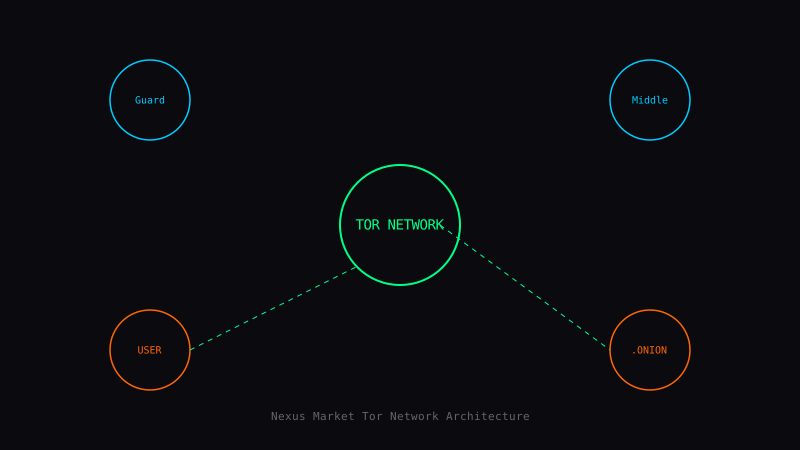
The Tor network consists of thousands of volunteer-operated relay nodes distributed globally. When you connect, your traffic passes through three of these relays in sequence: the entry guard (which knows your IP but not your destination), the middle relay (which knows neither), and the exit relay (which knows the destination but not your IP). For .onion hidden services like Nexus Market, the connection uses six relays total — three on your side and three on the server side — with a rendezvous point in the middle. This architecture ensures that neither you nor the hidden service can determine each other's network location. For more technical details on how this works, see the Wikipedia article on onion routing.
After connecting, you can verify your Nexus Market Tor connection is working by visiting the Tor Project's check page. The browser should confirm that you are connected to Tor and display your exit relay's IP address rather than your real IP. You can also view your current Tor circuit by clicking the lock icon in the address bar, which shows the country of each relay in your circuit. Once confirmed, you are ready to navigate to the Nexus Market onion link. If the connection fails, see the next section on using Tor bridges for censored or restricted networks.
# Verify Tor connection status
# Visit: https://check.torproject.org/
# Expected: "Congratulations. This browser is configured to use Tor."
5
Navigate to the Nexus Market .onion Address
With the Tor Browser connected and configured, you can now access Nexus Market and other Tor hidden services by entering their .onion address directly into the browser's address bar. Nexus Market onion addresses in the current v3 format are 56 characters long and end with .onion. These addresses are derived from the hidden service's public cryptographic key using ED25519 elliptic curve cryptography, which provides strong authentication guarantees — the Nexus Market address itself is a cryptographic proof of the server's identity.
Before the exit scam, the Nexus Market onion address was the primary access point for the Nexus Market platform. Users would paste the verified Nexus Market onion URL into the Tor Browser address bar and press Enter. The Tor network would then establish a rendezvous circuit to the Nexus Market hidden service, a process that could take anywhere from a few seconds to over a minute depending on network congestion. Once connected, the Nexus Market login page would load, and users would proceed through the Nexus Market authentication process including username entry, anti-phishing phrase verification, password submission, and PGP-based 2FA challenge if enabled on the account.
# Nexus Market onion address (OFFLINE since January 18, 2025)
nexusaldu7wwewcpcn4reptcp72rsaeogolfvjncafua2oywwswwyaqd.onion

# Always verify the address character-by-character before logging in
# Bookmark verified addresses with CTRL+D to avoid typosquatting
After accessing a hidden service, always verify its authenticity before entering any credentials. For Nexus Market, this meant checking the PGP-signed mirror list and confirming your anti-phishing phrase. Bookmark verified addresses immediately to avoid needing to type or paste them in the future. Never trust onion links shared through unverified channels such as paste sites, forum posts from unknown users, or messaging apps. For the complete list of known Nexus Market URLs and their current offline status, see our Nexus Market onion link directory.
Establishing a secure connection to the Tor network for Nexus Market access involves more than simply launching the Tor Browser and clicking connect. Depending on your geographic location, network environment, and threat model, you may need to configure additional tools and settings to ensure both your anonymity and your ability to reach the Nexus Market onion address. This section covers the most important connection security topics that were relevant when accessing Nexus Market and remain essential for anyone using the Tor network to reach Nexus Market or other hidden services. Understanding the relationship between VPNs, Tor bridges, and pluggable transports is critical for making informed decisions about your Nexus Market connection security.
Should You Use a VPN with Tor for Nexus Market?
The question of whether to use a VPN in combination with the Tor Browser when accessing Nexus Market is one of the most debated topics in darknet operational security. The Tor Project itself does not recommend using a VPN with Tor for most Nexus Market users, as it adds complexity without necessarily improving anonymity. When you connect to a VPN before launching Tor (the "VPN over Tor" configuration), your VPN provider can see that you are connecting to the Tor network, but your ISP cannot. This merely shifts trust from your ISP to your VPN provider. If your VPN provider logs your Nexus Market activity or is compelled to do so by legal process, this configuration provides no benefit.
However, there are specific scenarios where a VPN may be useful. If your ISP actively blocks Tor connections, a VPN can provide a pathway to reach the Tor network. In countries with deep packet inspection (DPI) that identifies and throttles Tor traffic, a VPN can help disguise your initial connection. For accessing marketplaces like Nexus Market, the consensus among security researchers was that Tor alone provides sufficient anonymity for most threat models, and adding a VPN introduces an additional point of failure and a third party who could potentially be compelled to provide records. The most secure approach remains using the Tor Browser on a dedicated operating system like Tails without any VPN involvement.
Tor Bridges for Nexus Market Access in Censored Regions
Tor bridges are unlisted relay nodes that help Nexus Market users in censored regions connect to the Tor network when direct connections to the publicly listed relays are blocked. Countries such as China, Iran, Russia, and others employ sophisticated network filtering that can identify and block standard Tor traffic used to reach Nexus Market. Bridges circumvent this censorship by providing entry points that are not included in the public Tor relay directory, making them harder for censors to identify and block.
To configure bridges in the Tor Browser, open the connection settings and select "Use a bridge." You can choose from built-in bridge types or request custom bridges from the Tor Project. The obfs4 pluggable transport is the most recommended option, as it transforms Tor traffic to look like random data, defeating deep packet inspection systems that analyze traffic patterns to identify Tor connections. The Tor Browser includes obfs4 support by default — you simply need to enable it in the connection settings. If built-in bridges are also blocked, you can request additional bridge addresses by visiting the Tor Project's bridge distribution page or by sending an email to bridges@torproject.org from a Gmail or Riseup email account.
Nexus Market Pluggable Transports — obfs4 and Beyond
Pluggable transports are protocols that transform Tor traffic to disguise it from network surveillance and censorship systems. The most widely deployed pluggable transport is obfs4, which obfuscates Tor protocol signatures by wrapping traffic in a layer of randomized padding that makes it indistinguishable from ordinary encrypted HTTPS traffic to automated analysis systems. Other pluggable transports include meek, which tunnels Tor traffic through major cloud providers like Microsoft Azure or Amazon Web Services, and Snowflake, which uses WebRTC peer connections through volunteer-operated proxies.
For users in heavily censored environments who needed to access Nexus Market or other darknet marketplaces, configuring obfs4 bridges was often the difference between being able to connect to Tor at all or being completely locked out. The Tor Browser makes this configuration straightforward through its connection assistant, which automatically detects if your network blocks standard Tor connections and suggests appropriate bridge configurations. Advanced users can also manually specify bridge lines in the Tor Browser configuration, allowing them to use privately operated bridge relays that are shared only among trusted contacts.
Nexus Market Connection Security Best Practices
Beyond the choice of VPN and bridge configuration, several additional connection security practices were essential for safely accessing Nexus Market through the Tor network. First, always ensure your Tor Browser is updated to the latest stable version before connecting to Nexus Market. The Tor Project regularly patches security vulnerabilities that could be exploited to deanonymize Nexus Market users. Second, never resize the Tor Browser window, as the window dimensions can be used as a fingerprinting vector to track your Nexus Market activity across different sessions. Third, disable automatic media playback in the browser settings, as embedded media can sometimes bypass Tor's proxy settings.
Additionally, monitor your Tor circuit regularly by clicking the lock icon next to the address bar. If you notice your circuit routing through countries with known surveillance programs, you can request a new circuit. For accessing sensitive hidden services, consider using the Tor Browser's "New Identity" feature (accessible through the broom icon) between sessions, which clears all cookies, closes all tabs, and builds entirely new circuits. This prevents any potential cross-session tracking. For the highest level of connection security, use the Tor Browser within Whonix, which isolates the Tor process in a separate virtual machine, ensuring that even if the browser is compromised, your real IP address cannot leak to the destination server.
03
Tor Browser Security Configuration for Nexus Market Darknet Access
Properly configuring the Tor Browser's security settings is one of the most important steps you can take to protect yourself when accessing Nexus Market and other darknet marketplaces. The Tor Browser ships with numerous privacy and security features built in, but several of these require manual configuration to reach their maximum protection level for Nexus Market access. The default settings prioritize usability over security, which is appropriate for casual browsing but insufficient for the heightened threat environment of Nexus Market darknet access. This section covers every critical security setting you should configure before navigating to the Nexus Market .onion address, including the settings that were essential for safe Nexus Market access. The Cloudflare Learning Center provides additional background on many of the web security concepts discussed here, including encryption protocols, DNS security, and browser fingerprinting techniques.
The Tor Browser's security slider, accessible through the shield icon in the toolbar, controls the overall security posture of the browser by enabling or disabling various features that can be exploited by malicious websites. Setting the slider to its highest level — "Safest" — disables JavaScript entirely, blocks web fonts that can be used for fingerprinting, prevents automatic media playback, and restricts several other browser features that have been historically exploited in attacks against Tor users. While this level of restriction may break some websites, well-designed darknet marketplaces including the former Nexus Market platform were built to function fully without JavaScript, specifically because the developers understood that security-conscious users would have it disabled.
✓Set Security Level to "Safest" for Nexus Market — This disables JavaScript, blocks web fonts, and restricts media. JavaScript is the single largest attack surface in any web browser, and disabling it eliminates the vast majority of browser exploit techniques that could target Nexus Market users. Nexus Market was fully functional with JavaScript disabled, as are most properly built darknet platforms. Keep this setting enabled at all times when accessing Nexus Market or any other hidden service.
✓Keep NoScript in Strict Mode — The Tor Browser includes the NoScript extension, which provides granular JavaScript blocking capabilities. In the "Safest" security level, NoScript blocks all scripts by default. Do not add exceptions for Nexus Market or any darknet marketplace site. If a site claiming to be Nexus Market requires JavaScript to function, this is itself a red flag — the legitimate Nexus Market did not require JavaScript for core functionality like browsing, purchasing, and account management.
✓Disable WebRTC to Prevent IP Leaks on Nexus Market — WebRTC (Web Real-Time Communication) can potentially leak your real IP address even when using the Tor Browser to access Nexus Market, bypassing the proxy configuration. While the Tor Browser disables WebRTC by default when the security level is set to "Safest," you should verify this by navigating to about:config and confirming that media.peerconnection.enabled is set to false. Any WebRTC leak would reveal your actual IP address to Nexus Market or a phishing mirror, completely compromising your anonymity.
✓Block WebGL Fingerprinting — WebGL (Web Graphics Library) allows websites to query your graphics hardware for rendering capabilities, creating a unique fingerprint based on your GPU model, driver version, and rendering behavior. This fingerprint can persist across sessions and be used to track your activity. The "Safest" security level restricts WebGL, but you can further harden your configuration by setting webgl.disabled to true in about:config. This prevents any website from accessing your graphics hardware information.
✓Manage Cookies Aggressively — Configure the Tor Browser to clear all cookies when you close the browser, and use the "New Identity" feature between marketplace sessions to eliminate any session-persistent tracking. While cookies are necessary for maintaining login sessions on marketplaces like Nexus Market, they should never persist beyond your active browsing session. First-party cookies are acceptable during a session, but all third-party cookies should be permanently blocked in the browser's privacy settings.
✓Never Maximize the Browser Window — The Tor Browser intentionally opens at a specific default window size to prevent fingerprinting based on screen resolution and window dimensions. Maximizing the window reveals your screen resolution, which combined with other factors can create a unique fingerprint. Always keep the Tor Browser at its default size. If you need more viewing area, use the browser's zoom function rather than resizing the window. This seemingly minor detail is one of the most commonly overlooked fingerprinting vectors for Tor users.
These six security configurations form the baseline for safe darknet marketplace access. When applied together, they dramatically reduce the information that any website — including malicious phishing mirrors or compromised hidden services — can collect about your system, your identity, and your browsing behavior. For additional reading on browser fingerprinting and the techniques used to track users across the web, the OWASP Foundation maintains extensive documentation on web application security threats, and the Electronic Frontier Foundation publishes accessible guides for non-technical users on protecting their digital privacy. Understanding these threats is essential for anyone who accessed Nexus Market or plans to navigate similar platforms on the dark web.
04
Recommended Operating Systems for Secure Nexus Market Access
The operating system you use to access Nexus Market and other darknet marketplaces is as important as the browser configuration. Running the Tor Browser on a standard Windows or macOS installation provides browser-level anonymity but leaves your entire operating system — including other running applications, cached files, and network services — exposed to potential surveillance and forensic analysis. Purpose-built security operating systems address these vulnerabilities by isolating your Nexus Market darknet activity from your regular computing environment, routing all network traffic through Tor at the system level, and leaving no forensic traces on the host machine. For accessing Nexus Market specifically, security-conscious users relied on one of the following operating systems, each offering different security trade-offs. Setting up 2FA on these systems is straightforward since they all include GnuPG for PGP-based two-factor authentication out of the box.
Tails OS for Nexus Market
Tails (The Amnesic Incognito Live System) is a portable Linux distribution that boots from a USB drive or DVD and runs entirely in RAM, making it ideal for accessing Nexus Market securely. Every network connection is forced through the Tor network at the operating system level, preventing any application from accidentally bypassing Tor and leaking your real IP address while browsing Nexus Market. When you shut down Tails, all Nexus Market session data is wiped from memory, leaving no forensic trace on the computer you used. Tails includes the Tor Browser, GnuPG for PGP operations and 2FA, the KeePassXC password manager, and encrypted persistent storage for Nexus Market credentials you need to preserve between sessions.
For Nexus Market users, Tails was considered the gold standard for operational security. Its amnesic design meant that even if your computer were seized by an adversary, no evidence of your darknet activity would be recoverable from the device. The combination of system-level Tor enforcement, memory-only operation, and built-in cryptographic tools made Tails the most recommended platform for darknet marketplace access by privacy advocates including the Electronic Frontier Foundation.
Whonix
Whonix uses a unique dual-virtual-machine architecture to provide strong anonymity guarantees. The Whonix-Gateway VM handles all Tor routing and network connectivity, while the Whonix-Workstation VM is where you perform your actual browsing and other activities. This separation means that even if the Workstation VM is completely compromised by malware, the attacker cannot discover your real IP address because the Workstation has no direct access to the physical network — all its traffic must pass through the Gateway, which only allows Tor connections.
Whonix is particularly well-suited for Nexus Market users who need persistent storage and a full desktop environment while maintaining strong anonymity. Unlike Tails, which wipes everything on shutdown, Whonix runs as permanent virtual machines that preserve your data, installed software, and configurations between Nexus Market sessions. This makes it convenient for regular Nexus Market access where you need to maintain PGP keyrings, browser bookmarks, Nexus Market password databases, and other persistent data. The trade-off is that Whonix does not provide the same forensic resistance as Tails, since the virtual machine images containing Nexus Market activity remain on the host disk and could theoretically be analyzed if the host system were compromised or seized.
Qubes OS for Nexus Market
Qubes OS takes a security-through-compartmentalization approach by running each application or category of applications in its own isolated virtual machine called a "qube." You can create separate qubes for different activities — one for personal browsing, one for work, one for Nexus Market darknet access — and these qubes are cryptographically isolated from each other at the hardware level using the Xen hypervisor. Qubes can integrate Whonix as a network backend, giving Nexus Market users the benefit of both Whonix's Tor isolation and Qubes' application compartmentalization.
For advanced users who accessed Nexus Market and other darknet marketplaces, Qubes with Whonix provided the most thorough security model available. A compromise in any single qube cannot spread to others, meaning that even a zero-day browser exploit targeting the Tor Browser would be contained within the darknet qube and could not access data in your personal or work qubes. This level of isolation comes at the cost of higher system requirements — Qubes needs at least 16 GB of RAM and a CPU with hardware virtualization support — and a steeper learning curve compared to Tails or standalone Whonix installations.
Standard Precautions (Windows/macOS/Linux)
If using a dedicated security OS is not feasible, the Tor Browser can still be used on standard operating systems with additional precautions. Disable all unnecessary network services and background applications before launching Tor. Use a standard, non-administrator user account. Enable full-disk encryption (BitLocker on Windows, FileVault on macOS, LUKS on Linux). Keep your operating system and all software fully updated. Use a firewall to block all traffic except the Tor Browser's connection. Disable Bluetooth and WiFi when not in use. Never run the Tor Browser alongside applications that connect to the internet using your real IP address, as network-level correlation attacks can link your Tor activity to your real identity.
Even with these precautions, a standard operating system does not provide the same level of protection as Tails, Whonix, or Qubes. Your browsing history, cached files, swap space, and other system artifacts may contain evidence of your darknet activity that could be recovered through forensic analysis. For casual research and educational browsing, these precautions may be sufficient. However, for activities requiring strong anonymity — such as the regular marketplace access that Nexus Market users required — a dedicated security operating system is strongly recommended. Configure PGP-based 2FA through GnuPG regardless of your operating system choice, as this provides critical account protection independent of your platform security posture.
05
Common Mistakes When Accessing Nexus Market & Other Darknet Markets
Even experienced Nexus Market and darknet marketplace users make critical security mistakes that can compromise their anonymity, lead to financial losses, or expose them to phishing attacks. The following list documents the ten most common errors observed among Nexus Market users and users of similar platforms. Each Nexus Market security mistake represents a real vulnerability that has been exploited by adversaries — including law enforcement, phishing operators, and malicious hidden service operators — to identify, steal from, or compromise darknet marketplace users. Avoiding these mistakes is essential for maintaining operational security on the dark web. Review the complete Tor access guide for the correct procedures, and visit our Nexus Market onion link page for the current status of all known marketplace URLs.
×Using a regular browser instead of Tor Browser for Nexus Market — Accessing Nexus Market through Chrome, Firefox, Safari, or any non-Tor browser exposes your real IP address directly to the hidden service, completely eliminating your anonymity. Regular browsers cannot resolve Nexus Market .onion addresses natively, and any third-party service claiming to proxy Nexus Market Tor traffic through a clearnet browser is capturing your traffic and potentially recording your credentials. The Tor Browser is the only software designed specifically for anonymous Nexus Market access.
×Lowering the JavaScript protection settings — Reducing the Tor Browser security slider from "Safest" to "Safer" or "Standard" enables JavaScript execution, which opens the door to a wide range of attacks including browser exploit kits, canvas fingerprinting, WebRTC IP leaks, and cross-site scripting. Legitimate darknet marketplaces including Nexus Market were designed to work without JavaScript. If a site requires JavaScript to function, treat this as a warning sign that the site may be malicious or poorly designed.
×Sharing your Nexus Market screen or taking screenshots — Screenshots and screen recordings capture sensitive Nexus Market information including onion URLs, account balances, order details, usernames, and anti-phishing phrases. This data can be extracted from your device by malware, discovered through forensic analysis, or inadvertently shared through cloud sync services. Never share screenshots of Nexus Market sessions, and disable any screen recording or clipboard monitoring software before accessing Nexus Market or other hidden services.
×Using a personal email address for registration — Linking your real email to a darknet marketplace account creates a direct connection between your real-world identity and your marketplace activity. Even encrypted email services can be subpoenaed or compromised. Nexus Market did not require email verification for account creation, and most security-focused marketplaces follow the same approach. If a marketplace requires an email, use a disposable address created over Tor with no connection to your real identity.
×Skipping PGP verification of mirror links — Accessing darknet marketplace mirrors without verifying their PGP signatures is one of the most common ways users fall victim to phishing attacks. Phishing sites can replicate the visual appearance of a marketplace perfectly, but they cannot produce a valid PGP signature from the marketplace's private key. Every Nexus Market mirror URL should have been verified through gpg --verify before entering any credentials. Skipping this step essentially means trusting an unknown party with your login details and cryptocurrency.
×Reusing passwords across marketplaces and services — Using the same password on Nexus Market and other accounts means that a single database breach, phishing attack, or exit scam exposes all your accounts simultaneously. Darknet marketplace databases are frequently leaked after seizures or shutdowns, and attackers systematically test recovered credentials against other platforms. Use a locally stored, encrypted password manager like KeePassXC to generate a unique high-entropy password for every marketplace account.
×Trusting clearnet links to Nexus Market — Any website on the regular internet claiming to provide working Nexus Market links should be treated with extreme suspicion. While some legitimate directories exist, the majority of clearnet "Nexus Market link" sites are phishing operations that list fake Nexus Market onion URLs designed to steal credentials and cryptocurrency. Always verify Nexus Market URLs through PGP-signed announcements from trusted community sources rather than through clearnet search results or advertisements.
×Ignoring the anti-phishing phrase verification — The anti-phishing phrase is a simple but highly effective defense against phishing sites. After entering your username on Nexus Market, the legitimate site would display your custom phrase. Many users became complacent and stopped checking this phrase, making them vulnerable to phishing mirrors that skipped or faked this verification step. Always pause after username entry and verify that your exact anti-phishing phrase appears before typing your password.
×Storing large amounts of cryptocurrency on the marketplace — The Nexus Market exit scam is a direct consequence of users storing more funds on the platform than necessary. When marketplace administrators hold custody of user cryptocurrency through centralized wallets, they have the technical ability to steal it at any time. Only deposit the amount needed for your immediate transactions, and withdraw remaining funds to a personal wallet you control. Use Bitcoin or Monero wallets on your own device rather than treating a marketplace as a bank.
×Skipping 2FA setup on your marketplace account — PGP-based two-factor authentication was one of Nexus Market's strongest security features, yet many users never enabled it. Without 2FA, a phishing site that captures your username and password gains full access to your account, including the ability to change your password, withdraw funds, and modify your settings. With PGP 2FA enabled, the attacker would also need your private key to complete the login, which provides a critical additional barrier. Enable 2FA immediately on any darknet marketplace that supports it — it is the single most impactful account security measure available.
06
Frequently Asked Questions — Nexus Market Tor Access
The following frequently asked questions address the most common queries about accessing Nexus Market through the Tor Browser, Nexus Market connection security, operating system recommendations for Nexus Market, and the current state of the Nexus Market platform following the January 2025 exit scam. Each answer provides detailed, actionable information based on established darknet security practices and the specific configuration requirements that applied to Nexus Market access.
The only safe source for downloading the Tor Browser to access Nexus Market is the official Tor Project website at torproject.org/download. Never download the Tor Browser from third-party websites, software download portals, app stores (except the official Google Play listing for Android), or links shared on forums and messaging platforms. After downloading, you must verify the file's PGP signature using the Tor Project's signing key to confirm the download has not been tampered with. The Tor Project publishes detailed verification instructions on their website, and the GnuPG tool is required for this verification process. On Linux systems, you can also verify the SHA256 checksum as an additional layer of confirmation. Compromised Tor Browser downloads specifically targeting Nexus Market users have been documented in the wild, with modified versions that record browsing history and steal Nexus Market credentials — making verification a non-negotiable security step before installation.
For most users, the Tor Browser alone provides sufficient anonymity without a VPN. Adding a VPN to your Tor configuration shifts trust from your ISP to your VPN provider without fundamentally improving your anonymity. If your VPN provider logs your connections or is compelled to do so by legal process, the VPN becomes a liability rather than an asset. The Tor Project does not recommend using a VPN with Tor for general anonymity purposes. However, a VPN may be useful in specific scenarios: if your ISP blocks Tor connections, if you are in a country that criminalizes Tor usage, or if you need to hide the fact that you are connecting to Tor from your local network administrator. In these cases, connect to the VPN first, then launch the Tor Browser. For the strongest anonymity guarantee when accessing darknet marketplaces like Nexus Market, use Tails OS without a VPN, as Tails routes all system traffic through Tor at the operating system level and provides amnesic session handling that leaves no forensic traces.
The safest Tor Browser security setting is the "Safest" level, accessible through the shield icon in the browser toolbar. This setting completely disables JavaScript execution, blocks web fonts, prevents automatic media playback, restricts certain HTML5 features, and limits the browser's rendering capabilities to minimize the attack surface available to malicious websites. For darknet marketplace access, the "Safest" setting is strongly recommended because it eliminates the vast majority of browser exploit techniques that have been used to deanonymize Tor users. Well-designed marketplaces like Nexus Market were built to function fully without JavaScript, so the "Safest" setting does not impact core marketplace functionality such as browsing listings, placing orders, or managing your account. The "Safer" setting provides a middle ground by disabling JavaScript only on non-HTTPS sites, while the "Standard" setting leaves all features enabled. Neither the "Safer" nor "Standard" setting is recommended for darknet marketplace access due to the elevated threat environment and the prevalence of malicious scripts deployed on phishing mirrors and compromised hidden services.
Tails OS is widely considered the best operating system for darknet marketplace access due to its combination of amnesic operation, system-level Tor enforcement, and built-in privacy tools. Tails boots from a USB drive, runs entirely in RAM, forces all network connections through Tor, and erases all session data on shutdown. For users who need persistent data storage between sessions, Whonix provides strong Tor isolation through its dual-VM architecture while maintaining a full desktop environment. The most advanced option is Qubes OS with Whonix integration, which adds hardware-level application compartmentalization to Whonix's network isolation. Each option represents a different point on the security-versus-convenience spectrum. For Nexus Market access, security researchers and experienced users consistently recommended Tails as the primary choice for most users, with Whonix or Qubes-Whonix for users with more advanced requirements or those needing persistent configurations.
To use Tor bridges to access Nexus Market in countries that block standard Tor connections, open the Tor Browser's connection settings before connecting. Select "Configure" rather than "Connect" on the initial screen, then check the option to use a bridge. The Tor Browser includes several built-in bridge types: obfs4 is the most recommended for Nexus Market access because it transforms Tor traffic into data that is indistinguishable from random noise, defeating deep packet inspection systems. Select obfs4 from the built-in bridge options and click Connect. If the built-in bridges are also blocked in your region, you can request custom bridge addresses by visiting the Tor Project's bridge distribution website or sending an email to bridges@torproject.org from a Gmail or Riseup email account. Enter the received bridge lines into the custom bridge configuration field. For the most restrictive network environments where Nexus Market users face severe censorship, the meek-azure transport tunnels Tor traffic through Microsoft Azure's content delivery network, making it appear as standard HTTPS traffic to Microsoft servers — this is extremely difficult for censors to block without disrupting all Azure services in the country.
Accessing darknet markets in 2025 carries significant risks that every user must understand and accept. The Nexus Market exit scam of January 2025 demonstrated that even popular marketplaces with tens of thousands of users can disappear overnight, taking all user funds with them. Law enforcement operations continue to target darknet marketplace infrastructure and users through advanced traffic analysis, undercover operations, and cryptocurrency tracing. The proliferation of sophisticated phishing mirrors means that a single moment of carelessness can result in credential theft and financial loss. That said, the Tor network itself remains reliable and provides strong anonymity when used correctly with proper operational security practices. If you choose to access darknet marketplaces, minimize risk by using Tails OS or Whonix, enabling PGP-based 2FA, verifying all URLs through PGP signatures, never storing more cryptocurrency than you can afford to lose, and treating every marketplace as a potential exit scam candidate. The Cybersecurity and Infrastructure Security Agency (CISA) publishes regular advisories on cyber threats that can inform your security practices.
07
Nexus Market External Resources & Further Reading
The following resources provide additional information about the technologies, tools, and security concepts covered in this Nexus Market Tor access guide. These links point to established, authoritative organizations and reference materials. Whether you are configuring the Tor Browser for Nexus Market access for the first time, setting up a secure operating system for Nexus Market, learning about cryptocurrency privacy, or researching the broader darknet ecosystem that hosted Nexus Market, these resources offer reliable and up-to-date information.
Privacy & Anonymity Tools for Nexus Market
The Tor Project — Official source for the Tor Browser, relay documentation, and anonymity research. The Tor network is the foundational technology for accessing Nexus Market and all darknet marketplace hidden services.
Tails OS — The Amnesic Incognito Live System, a portable operating system that routes all traffic through Tor and leaves no trace on the host computer after shutdown.
Whonix — A desktop operating system using dual-VM Tor isolation for advanced security and privacy, suitable for persistent darknet access configurations.
Electronic Frontier Foundation (EFF) — Leading nonprofit defending digital privacy and free speech, with extensive Surveillance Self-Defense guides for journalists, activists, and privacy-conscious individuals.
Privacy Guides — Community-maintained guide to privacy tools and services, covering Tor Browser, secure operating systems, and anonymous browsing practices for Nexus Market users.
Qubes OS — Security-focused operating system using hardware-level VM isolation. Qubes with Whonix provides the strongest security environment for accessing Nexus Market hidden services.
Nexus Market Cryptography & Verification
GnuPG (GNU Privacy Guard) — Open-source PGP implementation essential for verifying Nexus Market mirror signatures, encrypting Nexus Market communications, and setting up PGP-based two-factor authentication.
OpenPGP.org — Reference resource for the OpenPGP encryption standard used by Nexus Market for link signature verification, vendor-buyer communications, and PGP-based 2FA.
OnionShare — Open-source tool for securely sharing files and hosting sites over Tor, using onion services similar to those that powered the Nexus Market platform.
OWASP Foundation — Open Web Application Security Project providing resources on phishing, credential theft, browser security, and web application vulnerabilities.
CISA — The Cybersecurity and Infrastructure Security Agency publishes advisories, best practice guides, and educational materials on cyber threat protection.
Cryptocurrency Resources
Bitcoin.org — Official Bitcoin resource covering wallets, security practices, and the BTC payment protocol that was accepted on Nexus Market.
Monero (XMR) — Privacy-focused cryptocurrency with built-in transaction obfuscation through ring signatures and stealth addresses, also supported by Nexus Market.
Cryptocurrency — Wikipedia — Overview of digital currency technology, blockchain protocols, and the role of cryptocurrency in darknet marketplace economics.
KeePassXC — Free, open-source password manager for storing Nexus Market credentials, PGP passphrases, and cryptocurrency wallet data in an encrypted local database.
VeraCrypt — Open-source disk encryption tool for protecting sensitive Nexus Market files, PGP keys, and credentials in encrypted containers or full-disk volumes.
Educational References
Dark Web — Wikipedia — Overview of the dark web's structure, access methods, and relationship to the broader internet ecosystem including darknet marketplaces.
Tor Network — Wikipedia — Detailed article on the Tor anonymity network's relay architecture, circuit building, and hidden service protocol.
Onion Routing — Wikipedia — Technical explanation of the layered encryption protocol that enables anonymous communication through the Tor network.
Cloudflare Learning Center — Free educational articles on DNS security, DDoS protection, encryption protocols, and internet infrastructure concepts relevant to understanding darknet operations.
VPN — Wikipedia — Explanation of Virtual Private Network technology, its benefits, limitations, and relationship to Tor-based anonymity systems.
Return to our Nexus Market onion link page for the complete mirror directory, onion URL status dashboard, and PGP verification instructions. For the full security and verification guide including PGP mirror authentication and anti-phishing protection, see our dedicated Tor access guide.